
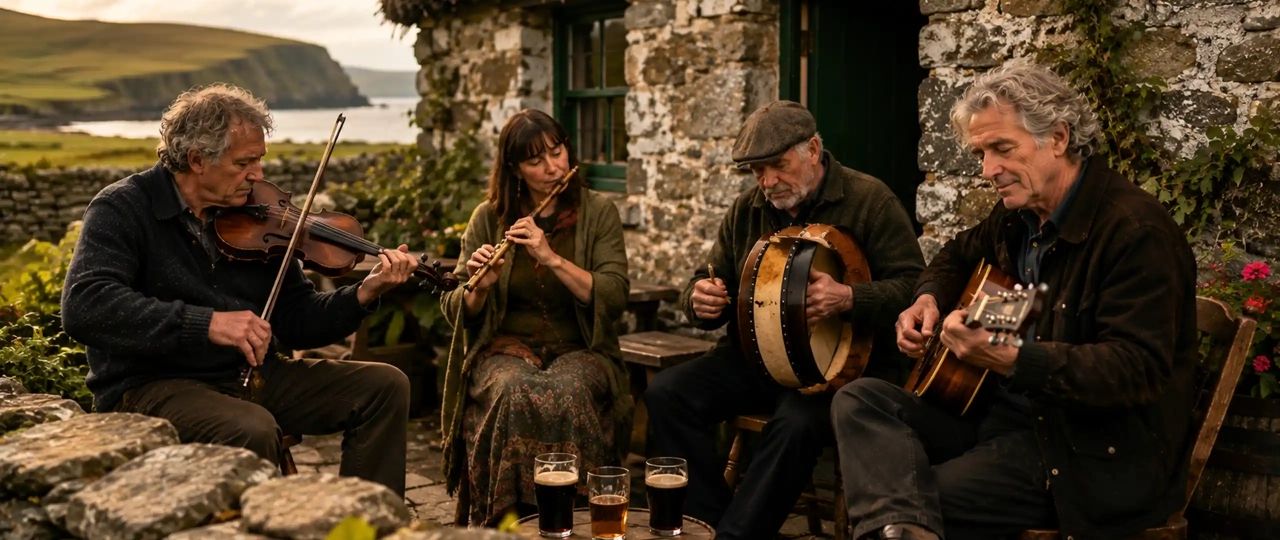
There is something special about an Irish ballad. A good ballad doesn't simply tell a story. It can carry the history, hopes, sadness and memories of generations of people. Some songs have been sung for decades, yet somehow they never seem to grow old.
Having spent a lifetime listening to, playing and recording Irish music, I have often wondered what gives these songs such staying power. I think much of it comes from the stories behind them.
Having spent a lifetime listening to, playing and recording Irish music, I have often wondered what gives these songs such staying power. I think much of it comes from the stories behind them.
The Fields of Athenry
Few modern Irish ballads have become as widely known as The Fields of Athenry.
Written by Pete St. John in the 1970s, the song is set during the Great Famine and tells the story of Michael, a man sentenced to transportation to Australia after stealing food for his family.
Although the story is fictional, the circumstances are rooted in a very real and painful period of Irish history. What makes the song so powerful is its simplicity. The melody is easy to remember, the words tell a clear story and the chorus almost invites people to sing together.
Over the years, it has moved far beyond the world of Irish ballad singing. It has become a song of identity and belonging, heard at sporting events, concerts and gatherings all over the world.
The Town I Loved So Well
Another song that carries enormous emotional weight is The Town I Loved So Well, written by Phil Coulter.
The song describes Coulter's home town of Derry and reflects on how a place remembered from childhood can be transformed by conflict and hardship. It begins with memories of a much simpler life and gradually becomes something much more poignant.
For me, this is one of the great strengths of Irish songwriting: a personal story can become something that thousands of other people recognise as their own.
You don't have to have lived in Derry to understand what it means to miss the place you grew up.
The Galway Shawl
Then there are the older traditional ballads, such as The Galway Shawl. Unlike songs written by a named modern songwriter, traditional songs often have uncertain origins. They were passed from singer to singer, changing slightly as they travelled from one place to another.
That is part of their charm. The Galway Shawl is essentially a love song, built around memories of a young woman and her appearance at a dance. The story is simple, but it captures something very familiar about Irish life — music, dancing, romance and the excitement of meeting someone special.
Songs like this remind us that Irish ballads weren't always about great historical events. Sometimes they were simply about ordinary people and ordinary lives.
The Wild Rover
The Wild Rover is another song that has travelled remarkably well. Its origins are difficult to pin down precisely, and versions of the song existed before it became strongly associated with Irish folk music. The story is familiar: a man who has spent years drinking and wandering decides to change his ways and return home.
The appeal is obvious.It has a catchy chorus, a strong rhythm and a story that can be enjoyed with a smile.It also demonstrates something important about Irish ballads. Not every song has to be sad.
Irish music has always contained humour, celebration, mischief and good-natured storytelling alongside the songs of emigration, loss and hardship.
The Parting Glass
Few songs create quite the same atmosphere as The Parting Glass. It has become one of the best-known farewell songs in the Irish and Scottish tradition, although its precise origins are much older than many modern performances might suggest.
The song is often sung at the end of an evening, when people are saying goodbye. That setting gives it a special emotional quality.
The words look back at friendships, mistakes and relationships before offering a final farewell. Perhaps that is why it continues to be sung at wakes, weddings, concerts, family gatherings and the end of many memorable evenings.
Why Do These Songs Survive?
When you look at these songs together, they are very different. Some tell stories about famine and hardship. Others are about love, home, emigration, friendship, drinking, dancing or saying goodbye. Yet they have something in common.
They make us feel something. That, I believe, is the secret of a great ballad. The melody matters. The words matter. The singer matters. But the emotional connection matters most.
A technically perfect recording of a song can still leave you unmoved. A simple voice accompanied by a guitar can sometimes have far greater impact. I've experienced this many times during my years as a musician and recording engineer.When somebody sings an Irish ballad and really believes the words, you can hear the difference.
Songs That Carry Memories
Perhaps another reason Irish ballads have survived is that they become attached to our own memories. We remember hearing a particular song from our parents. We remember singing it in a pub. We remember an old dance hall, a family gathering or somebody who is no longer with us.
Eventually, the song becomes part of our own story. That is when a traditional ballad becomes more than a piece of music. It becomes a memory. And this is why I believe Irish ballads will continue to survive, even as the way we listen to music changes.
We have moved from the old wireless to vinyl, cassettes, CDs, digital recording and streaming. The technology changes. The way we listen changes. But a great story, carried by a great melody, remains powerful.
Perhaps that is the real magic of Ireland's beloved ballads. They don't just tell us where we came from. They remind us who we are. And as long as somebody is willing to sing them, the stories will continue.